
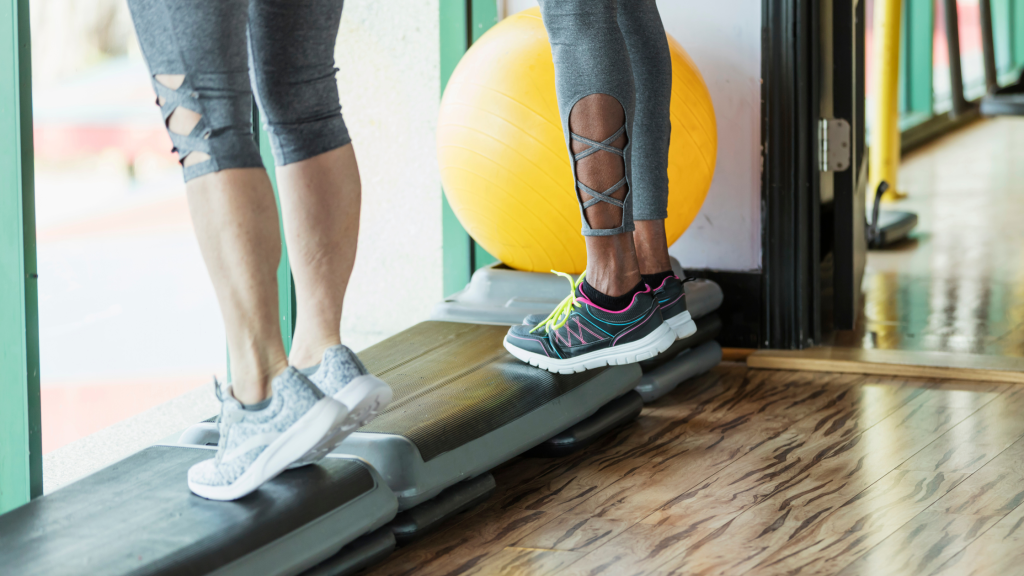
When people think about lower-body strength, the calves often get overlooked. Yet, the soleus and gastrocnemius play a crucial role in sprinting, jumping, running economy, and protecting the achilles tendon from overload. Assessing and training calf strength and endurance are vital to performing at your best, and ensuring an injury free summer of running. So, how strong should your calves be? Let’s break down the science and practical benchmarks.

Seated Calf Raise – Why is it Important?
A seated calf raise targets the soleus muscle. The soleus produces up to 6–8 times bodyweight in force during running (Bohm et al., 2015), making it essential for shock absorption at the achilles tendon. Strong soleus function has been linked to sprint performance, jump resilience, and reduced risk of overuse injuries (Sato et al., 2021).
Strength Standards for Calves (Seated Position)
- General Population: ~0.5 × bodyweight
- Recreational / field sport athlete: ~1.0 × bodyweight
- Well-trained athlete: ~1.25–1.5 × bodyweight
- Elite (sprinters, jumpers, rugby, football): ~1.75–2.0 × bodyweight
Example: an 80 kg athlete should aim for 120kg+ on a seated calf raise machine as a long-term target.
Symmetry Matters
Strength differences between left and right should be within 10 percent, as asymmetries larger than 10 percent are associated with increased risk of calf and achilles injuries (Silbernagel et al., 2012). So be sure to try some single leg repetitions and compare your left and right!
Seated vs. Standing Calf Raise Comparison
Your standing calf raise (straight-knee, gastroc focus) will naturally be stronger than your seated calf raise (bent-knee, soleus focus). Here’s a quick comparison:
| Level | Standing Calf Raise | Seated Calf Raise |
| Untrained | ~0.75 × BW | ~0.5 × BW |
| Recreational | ~1.25 × BW | ~1.0 × BW |
| Well-trained | ~1.75 × BW | ~1.25–1.5 × BW |
| Elite Athlete | ~2.25 × BW | ~1.75–2.0 × BW |
If the seated number lags more than expected, it may suggest weakness in the soleus compared to the gastrocnemius (Sato et al., 2021).
Calf Endurance
Normative values for calf raise endurance are widely used in physiotherapy, with 25 single-leg (standing calf raises) considered a baseline for return-to-sport (Silbernagel et al., 2012; Hébert-Losier et al., 2017).
Endurance Standards – Single-leg (standing) calf raises (bodyweight)
- General population: 20+ reps
- Runners & field athletes: 25–30 reps
- Elite jumpers/sprinters: 35–40 reps
Summary
- Aim for 1–1.5 × bodyweight on the seated calf raise as a baseline, with 1.75–2 × bodyweight for elite performance.
- Keep left/right differences within 10%
- Build up to 25+ single-leg standing calf raises for endurance and injury resilience.
For thorough testing of your calf strength, book in with our expert team to get tested by our VALD testing equipment
References
Bohm, S., Mersmann, F., & Arampatzis, A. (2015). Human tendon adaptation in response to mechanical loading: A systematic review and meta-analysis of exercise intervention studies on healthy adults. Sports Medicine, 45(4), 559–577. https://doi.org/10.1007/s40279-014-0280-9
Hébert-Losier, K., Wessman, C., Alricsson, M., & Svantesson, U. (2017). Updated reliability and normative values for the standing heel-rise test in healthy adults. Physiotherapy, 103(4), 446–452. https://doi.org/10.1016/j.physio.2016.12.001
O’Brien, T. D., Reeves, N. D., Baltzopoulos, V., Jones, D. A., & Maganaris, C. N. (2010). Mechanical properties of the patellar tendon in adults and children. The Journal of Physiology, 588(2), 225–237. https://doi.org/10.1113/jphysiol.2009.183350
Sato, S., Shimizu, T., & Yamamoto, Y. (2021). The role of soleus muscle strength in sprint performance and injury prevention: A systematic review. Journal of Sports Sciences, 39(8), 876–884. https://doi.org/10.1080/02640414.2020.1851882
Silbernagel, K. G., Steele, R., & Manal, K. (2012). Deficits in heel-rise height and Achilles tendon elongation occur in patients recovering from an Achilles tendon rupture. The American Journal of Sports Medicine, 40(7), 1564–1571. https://doi.org/10.1177/0363546512447926

