
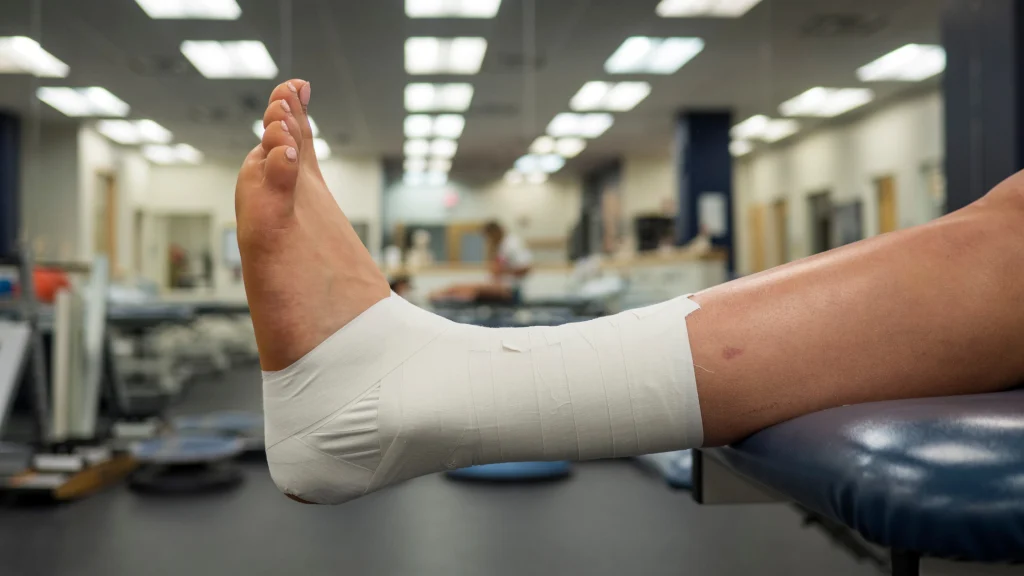
A lateral ankle sprain (LAS) is one of the most common sports injuries. It usually happens when the foot rolls outward (inversion) and often with plantarflexion (Wagemans et al., 2022). The anterior talofibular ligament, the main lateral ligament, is involved in the majority of these injuries (Hung, 2015).
From an exercise‑physiology perspective, the real story isn’t just the ligament. A sprain affects strength, proprioception, neuromuscular control, and can have knock-on effects up the kinetic chain. Hip, knee and trunk if not managed well (Hung, 2015; De Fazio et al., 2025).
Acute Care: Why Good Practice Matters

How you handle the first few days can set the tone for recovery. The literature shows:
- Early functional rehabilitation (moving within pain limits) is superior to just resting the ankle (Van den Bekerom et al., 2022).
- Exercise‑based rehab reduces risk of recurrence (Wagemans et al., 2022).
- Waiting too long to start movement or rehab increases chances of chronic instability or repeated sprains (Rehabilitation strategies for lateral ankle sprain…, 2023).
Practical EP takeaways:
- In the first 24–72 h, manage swelling and pain but start gentle ankle movement as tolerated.
- Begin upper limb strength and opposite sided leg training early to maintain overall capacity.
- Know that a sprain isn’t “just 2 weeks off” full recovery is about weeks of targeted rehab.
Pain Science Perspective of Lateral Ankle Sprains

LAS is interesting from a pain science view:
- Acute injury triggers nociceptive input, swelling, and protective guarding. In other words, when you sprain your ankle, your body feels pain, swells, and naturally tightens muscles to protect the joint.
- But even when tissue heals, athletes can feel instability or “giving way,” reflecting sensorimotor changes and central adaptations (Mohamadi et al., 2025). In other words, even after the ankle ligament has healed, you might still feel wobbly or like it could give out because your brain and nerves haven’t fully learned to control the joint yet.
- Fear or previous injury can make athletes adopt protective movement patterns. Stiffer landings, less dorsiflexion and this can raise re‑injury risk (Guo et al., 2024). In simple terms, If you’re scared of hurting your ankle again, you might move differently, landing more stiffly or not bending your ankle fully, which can actually make another sprain more likely.
To keep it simple! Your ankle ligament is like a rope that got a bit frayed. We patch it up, but if you never walk on uneven ground again, you’ll keep tripping. Rehab is about strengthening the rope and retraining your body to trust it.
Contralateral Side, Cardio & Upper‑Body Strength
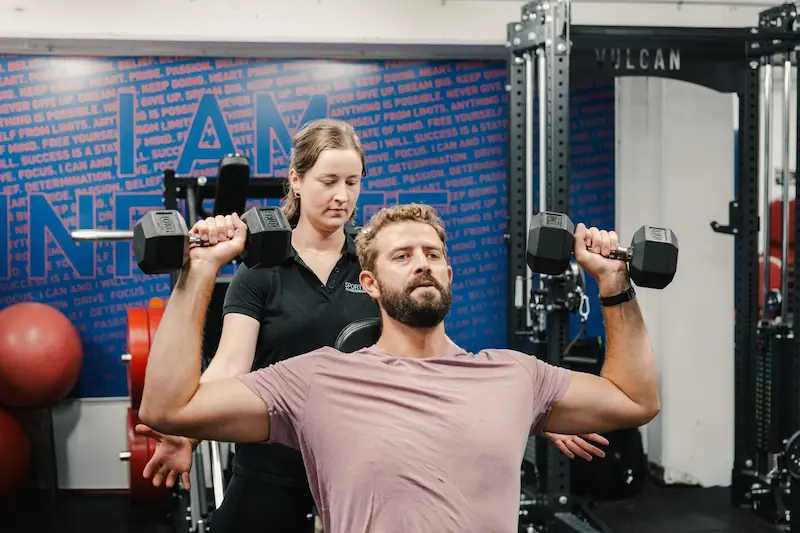
When the ankle is injured, the natural instinct is “just rest the leg.” But for most people, that’s sub‑optimal. Below are some simple ideas to keep the body moving in a safe, effective way to maximise long-term recovery.
Contralateral limb training (working your uninjured side)
- Keep the uninjured leg strong; some neural “cross‑education” benefits may transfer to the injured side (Tedeschi, 2024).
- Even if your injured ankle can’t do much yet, training the other leg can help your injured ankle stay a bit stronger too, because your brain shares some of the benefits.
Cardio / aerobic work
- Time off can mean you lose some of your cardiovascular fitness. Options: upper‑body ergometer, hand‑bike, pool work.
- Supports systemic fitness, circulation, and morale.
Upper‑body / full‑body strength
- Maintain strength in arms, trunk, and core.
- Supports overall athleticism and neural drive so that return to full training is smoother (Hung, 2015; De Fazio et al., 2025).
Rehabilitation Phases
Phase 1: Protection → Early Movement (0–2 weeks)
- Manage pain/swelling, start ankle AROM, non‑painful isometrics.
- Begin proximal and contralateral limb work.
- Upper‑body/cardio work as tolerated (Evans & Haines, 2005).
Phase 2: Strength, Proprioception, Load (Weeks 2–6)
- Ankle strengthening (eversion/inversion), calf raises, single‑leg balance.
- Progress lower‑body strength as tolerated.
- Cardio progression; maintain upper‑body training.
- This phase reduces reinjury risk (Wagemans et al., 2022; Van den Bekerom et al., 2022).
Phase 3: Sport‑Specific, Return to Performance (6 weeks+)
- Multi‑plane movements, jumps, landing, cutting drills.
- Full-body strength + upper body maintained.
- Use objective criteria (strength symmetry, movement quality, balance, confidence) for return-to-sport decisions (Rehabilitation strategies for lateral ankle sprain…, 2023).
- Sometimes strapping may be necessary to bridge the return to sport gap.
Practical EP Tips
- Track movement quality, not just time.
- Don’t neglect the hip/glute/foot chain the ankle doesn’t work in isolation (Mohamadi et al., 2025).
- Educate on sensorimotor retraining.
- Combine balance and strength training for best outcomes.
- Keep engaged with upper-body/cardio work to preserve confidence and fitness.
Key Take‑Home Points
- LAS affects the joint, neuromuscular control, and the whole kinetic chain.
- Early functional rehab is critical.
- Progress based on movement quality and readiness, not just pain-free days.
- Pain science: rebuild confidence, restore sensorimotor control, avoid maladaptive strategies.
References
De Fazio, A., et al. (2025). Functional and neuromuscular effects of rehabilitation in chronic ankle instability.ScienceDirect.
Evans, P., & Haines, T. (2005). Acute management of lateral ankle sprain: a practical approach. Physical Therapy in Sport, 6(3), 143‑150.
Guo, Y., et al. (2024). A systematic review and meta‑analysis of balance training in chronic ankle instability. Systematic Reviews, 13, Article .
Hung, Y. (2015). Neuromuscular control and rehabilitation of the unstable ankle. PMC.
Mohamadi, S., et al. (2025). Neuromuscular control in chronic ankle instability, copers and healthy controls: a meta‑analysis. Sports Biomechanics, Article .
Rehabilitation strategies for lateral ankle sprain do not reflect established mechanisms of re‑injury: A systematic review. (2023). Physical Therapy in Sport, 60, 75‑83.
Tedeschi, R. (2024). Rebuilding stability: Exploring the best rehabilitation interventions for chronic ankle instability.Sports, 12(10), 282.
Van den Bekerom, M. P., et al. (2022). Acute Ankle Sprain Management: An Umbrella Review of Systematic Reviews.Frontiers in Medicine.
Wagemans, J., Bleakley, C., Taeymans, J., Schurz, A., Kuppens, K., Baur, H., & Vissers, D. (2022). Exercise‑based rehabilitation reduces reinjury following acute lateral ankle sprain: A systematic review update with meta‑analysis. PLoS ONE, 17(6), e0260507.

